
Thriving. Not just surviving. Is that even possible? Believe it or not, yes, it is possible. And it’s actually not that hard, which is really counter-intuitive when you’re just trying to keep your head above water in survival mode.
But you can’t get there by trying harder, which, although counter-intuitive, is really good news. Thriving doesn’t require more effort. It requires intentionality. Thriving doesn’t happen by itself or by accident. You need to bake these 4 things into your life.
1) Devotion with Jesus
Note the word “with.” Devotion “with” Jesus, not devotion “to” Jesus. Yes, I’m taking for granted that, in this Christian space, we’re all devoted to Jesus. That’s good. But that’s also where our unhealthy striving can kick in:
“If I could just be a better Christian… If I could just try harder… I’ll do better this time…”
No. Trying harder doesn’t work when you’re already trying as hard as you can. Instead of trying harder for Jesus, what would happen if we did what we’re already doing with Jesus?
Is there a part of our life that Jesus is not invited into? That we’d be ashamed if our parents or church friends knew? Maybe it’s our behavior at work. Or with a certain group of friends. Or the way we swear at the traffic. What would it look like if we did that with Jesus? If we invited him into that space, what would change? How would we change?
A great resource for fostering this paradigm shift is the little devotional book, I Hear His Whisper, by Brian Simmons and Gretchen Rodriguez (not an affiliate link). Each devotion is written as a short, 2-paragraph, letter from God to you.
(Don’t worry that there’s 365 devotions, each dated for one day of the year. You don’t have to start on January 1. Just read one short page a day; it takes less than 5 minutes. And dwell on that thought the rest of the day. It will rewire how you think.)
2) Rest – Sabbath and Sleep
Sabbath. A big paradigm shift for me over the last few years was the concept of Sabbath – intentional rest. A God-given day off.
I blogged about my Sabbath journey as I was learning it here:
- A Sabbath Rest without Guilt
- A Sabbath Priority
- A Godly, Sabbath Rest
- What I’m Learning about God’s Rest
Overtly, intentionally, taking Sundays off has made a huge, huge difference for me. Janet and I look forward to it. We go so hard during the week, it’s become a non-negotiable, not a luxury.
Sleep. I wrote a post explaining how I partner with my body and with God for my sleep here. Basically, I balance letting my body get the sleep it needs with getting up early enough for the day’s work by not setting an alarm. I know that sounds crazy, but it works. I feel so much better if I wake up naturally versus sleeping longer but waking up to an alarm.
Before going to sleep, I ask God to wake me in the morning when he knows I need to get up. There’s a scary vulnerability trusting God for this, where the rubber meets the road, but he’s faithful. And I tell my body what time I want to wake up. I have no idea why this works, but it totally does.
The beauty of not setting an alarm is, on the occasions when my body needs more sleep than my schedule wants to give it, my body can have it.
Honor your season of life. If you have young children, Sabbath and sleep will look very different for you than it does for us as empty-nesters. If you’re a first responder, a Sunday Sabbath might not be an option. You might need a different day of the week. It might be a different day every week. It just needs to be intentionally selected, or it’ll never happen. The trick is to, somehow, build some rhythm of regular rest into your life.
3) Whitespace
Paradoxically, although whitespace is restful, rest and whitespace are not the same thing. This has been a paradigm shift for me this year.
Whitespace is unscheduled time. It’s the pad and margin between planned activities. It’s the evening during the week with no activity planned. It’s the space we have to breathe.
Even after figuring out how to take regular Sabbath days and get the sleep my body needs, I still felt exhausted and overwhelmed most of the time. Because I had every minute of every day scheduled. Even my rest time was scheduled, which made resting just another task. There was no moment to breathe.
If you have children with multiple activities, I get it, whitespace can seem completely undoable. And some days or weeks it will be. But ask the Holy Spirit to show you what you can let go of to build some whitespace into your life.
Maybe you can start a practice of, in general, when someone asks for an appointment or an activity that would force every minute of that day or week to be scheduled, it’s an automatic no. Or maybe you don’t allow 3 days in a row without whitespace.
It’ll look different for everyone. But it needs to look like something. You can’t thrive without whitespace.
4) Community
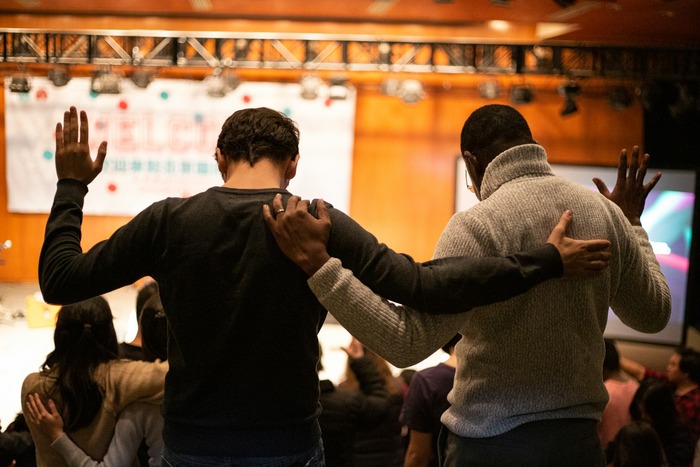
Healthy, Christian, community. We often forget this one. Or we confuse it with checking a box: “I went to church Sunday, got my community.”
That won’t do. Spending a few hours with people in a structured setting, like a church service, doesn’t count as Community. Community is having people you do life with. They know the good, the bad, and the ugly, and they love you, accept you, and support you anyway.
And , yes, they challenge you. That’s how we grow. Healthy community isn’t just a bunch of cookie-cutter people who look and sound like us, reinforcing our own echo chamber. Healthy community challenges us to grow and think differently. You can check out this post, 3 Ways Healthy Churches Do Life Together, for what a healthy church community looks like.
Your Turn
So you need these 4 things to thrive:
- Devotion with Jesus
- Rest
- Whitespace
- Community
Is anything on this list surprising? Which ones do you have? Which ones are you working on or struggling to find? Tell us your story in the comments. What you’ve experienced, or are going through, will help others.
Did this stir something in you?
Is thriving even possible? Did you give up on thriving a long time ago? Are you just trying to keep you head above water in survival mode? Please reach out to Dave and Janet here for an inner healing session. We use a method called The Immanuel Approach, a facilitated safe, gentle way to experience a connection with Jesus, get unstuck, and receive the healing he has for you.
Please Share
Please share this post if it would bless others. You are a critical part of helping us get this message out to those who need it.